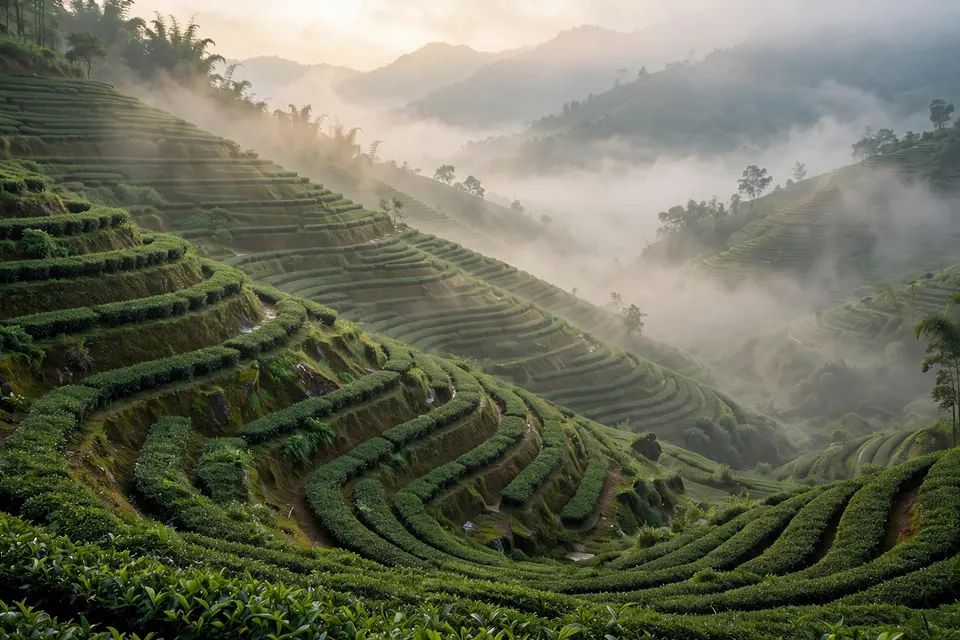
Where Chinese tea comes from is often why two teas with similar names can taste so different. The place leaves a mark on the leaf, and over centuries each region has settled into the teas it makes best. Soil, altitude, rainfall, and local habit all leave a mark on the leaf, and over centuries each region has settled into the teas it makes best.
You do not need to memorise a map of where Chinese tea comes from. But knowing five regions gives you a shortcut: when you like a tea, you know where to look for its neighbours.
Zhejiang: green tea country
Zhejiang, on the east coast, is green tea country. The best-known example is Longjing, a flat, smooth green tea that tastes fresh and a little nutty. If you like green tea that is clean and gentle rather than grassy and sharp, Zhejiang is the region to explore first.
Fujian: white tea and oolong
Fujian, just south of Zhejiang, is the home of both white tea and oolong. Its white teas are quiet and soft, the kind to drink when you want something calm in the cup. Its oolongs, such as Tieguanyin, sit further along the scale — floral or roasted, depending on how they are made. One province, two very different moods, which is why Fujian is a good second stop for beginners.
Anhui: everyday yellow tea
Anhui, inland to the west, is where Huoshan Huangya comes from — the yellow tea that is a little more everyday and forgiving than its famous cousins. Anhui's teas tend to be gentle and easy to brew, a good match for drinkers who want flavour without fuss.
Hunan: delicate yellow tea
Hunan, further inland, is home to Junshan Yinzhen, the classic, delicate yellow tea made mostly from buds. It is the quieter, more refined end of yellow tea, and it shows how one small region can keep a very particular style alive for a very long time.
Yunnan: pu-erh country
Yunnan, in the south-west, is pu-erh country. Pu-erh is pressed into cakes, bricks, or small nests, then aged, and it changes over time in a way no other Chinese tea quite does. It can be raw and lively when young, or smooth and earthy after aging. If you like the idea of a tea that evolves, Yunnan is where that story starts.
That is the whole map of where Chinese tea comes from, at beginner level: Zhejiang for green, Fujian for white and oolong, Anhui and Hunan for yellow, Yunnan for pu-erh. Pick the region behind a tea you already like, try one neighbour from the same place, and you will start to taste what a region actually means — not a label on a packet, but a habit of making tea, kept up for generations.