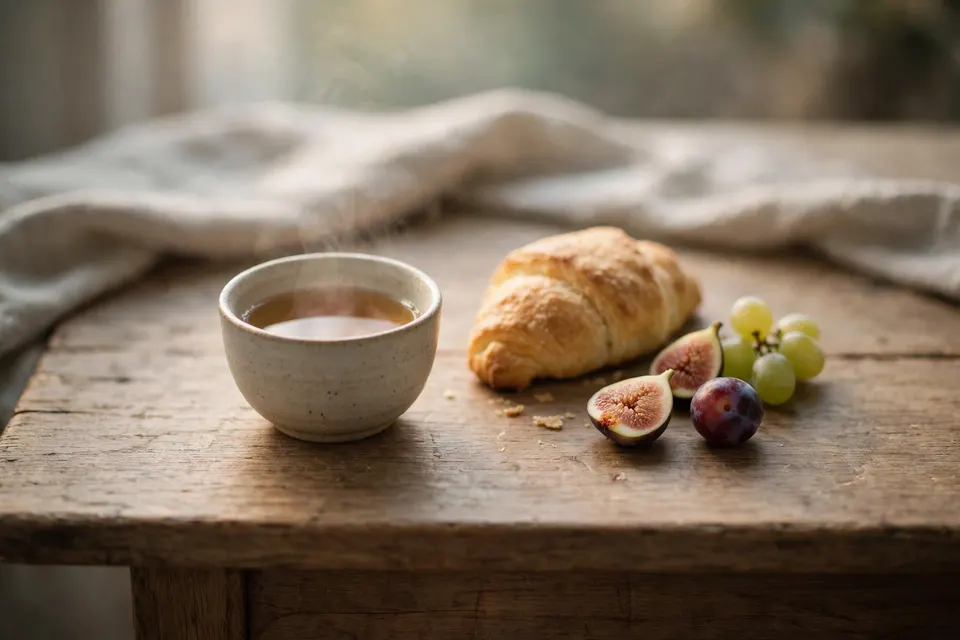
If you have ever taken a sip of tea with a meal and thought it tasted thin, or sharp, or simply wrong, the tea was probably fine. The pairing was off. Tea and food pairing has one rule at its heart: tea pairs best when the food does not overpower it, and when the tea gets a chance to clear the palate between bites.
The one rule: match the weight
One rule covers most cases in tea and food pairing: match the weight. A light tea goes with light food. A heavier, roasted or aged tea can stand up to richer food. When the food is much stronger than the tea, you will taste only the food. When the tea is much stronger than the food, you will taste only the tea. The best pairings sit in the middle, where each one makes the other clearer.
Green tea
Green tea, which is fresh and a little grassy, suits plain, light food: steamed vegetables, plain rice, a simple piece of fish, or a lightly salted snack. It is also the easiest tea to pair with fruit, because its clean taste does not fight with sweetness. If the food is oily or heavily spiced, green tea will feel lost — save it for a lighter plate.
White tea
White tea is quieter still, so keep its company simple: a plain pastry, a few berries, or nothing at all. White tea is the one to choose when you want the food to be the main event and the tea to be a soft background. It is also forgiving in the morning, when a strong tea can feel like too much before breakfast has settled.
Oolong
Oolong sits in the middle, and it is the most useful pairing tea. A lightly roasted oolong goes well with roasted nuts, roasted vegetables, and plain baked goods. A more deeply roasted oolong can handle richer food, such as a roast dinner or a small piece of dark chocolate, because its warm, toasted notes meet the food halfway instead of being pushed aside.
Black tea
Black tea — the kind Chinese tea drinkers call red tea — is the boldest of the everyday teas, so it pairs with food that has some richness of its own: buttered toast, a pastry with filling, or a hearty breakfast. If you drink it with very plain food, it can feel too strong; a splash of milk is a normal choice here, not a mistake.
Dark tea
Dark tea, including pu-erh, is the tea for heavy, oily meals. Its deep, earthy taste cuts through richness in a way lighter teas cannot, which is why it is often served after a large meal. Keep the portion small and the food simple, and let the tea do the clearing work between bites.
One habit that makes any pairing better
Whatever tea you choose, one habit makes any pairing better: sip, then eat, then sip again. Tea is not only a drink beside the food; it is a pause between bites. That pause is what lets you taste the next bite properly, instead of letting flavours pile up on each other.
Start with the tea you already like
Start your tea and food pairing with the tea you already like, and pair it with one plain food from the list above. If it works, you have a pairing. If it does not, change the food, not the tea — the tea you enjoy is the right starting point, and the pairing should bend around it.