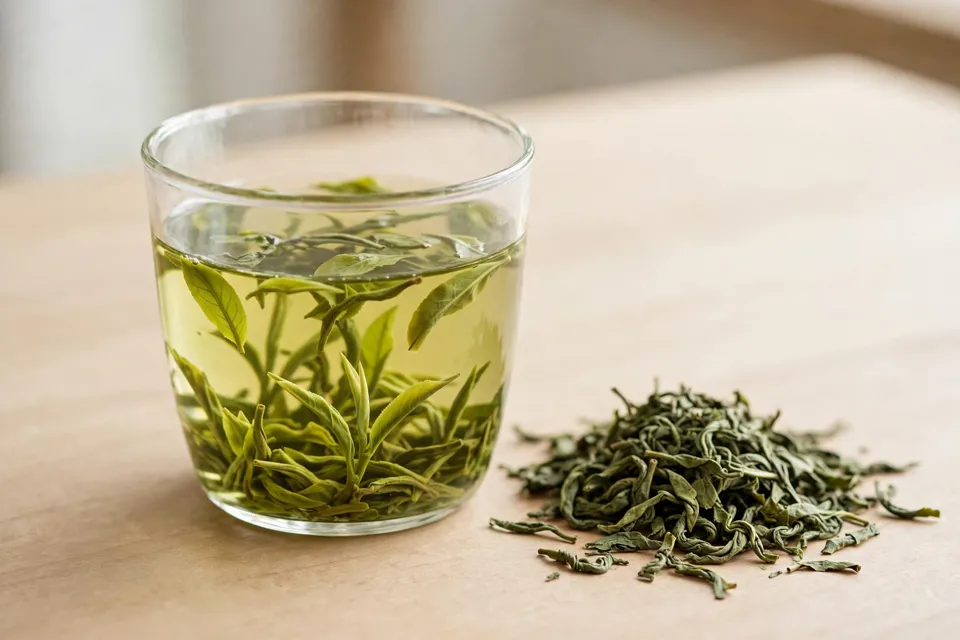
Green tea for beginners is the freshest-tasting of the Chinese teas, and the easiest to spoil with water that is too hot. Get the water right, and it almost brews itself. It is the oldest style of Chinese tea, and still the one most people in China drink every day — not for ceremony, but because it is light, clean, and easy to make in a plain glass.
What makes green tea green
All tea comes from the same plant. What makes green tea green is what does not happen to it: after picking, the leaves are heated quickly, usually in a hot pan or with steam, to stop them from darkening. They keep their green colour and their fresh, grassy character. Nothing is added, and nothing is aged. That is why green tea tastes the closest to the living leaf, and why it is also the most sensitive to how you brew it.
What it tastes like
Good green tea tastes fresh and light, with a gentle sweetness underneath. Some are grassy and bright, like a spring field. Others are softer, with a roasted, nutty note — the famous Longjing from Hangzhou has a hint of chestnut. A few, like Biluochun, carry a faint fruitiness. What they share is a clean finish: the taste arrives, and then it leaves, without coating your mouth. If your green tea tastes harsh or bitter, that is usually the brewing, not the tea.
How to brew it
Green tea wants cooler water than most teas: around 80 degrees, not boiling. Boil the kettle, then let it sit for a minute or two, or pour it into a cold cup first to take the edge off the heat. Use about two to three grams of leaves for a 150-millilitre cup — roughly a small pinch — and steep for one to two minutes. A glass cup is a good choice for beginners, because you can watch the leaves slowly sink and open, and you will know it is ready by the colour: a pale, clear green-gold. Like most good loose-leaf tea, the same leaves can be steeped again, two or three times, with each cup a little softer than the last.
The mistakes that make it bitter
Almost every bad cup of green tea comes from one of three mistakes. The first is water that is too hot: boiling water pulls out bitterness that cooler water leaves alone. The second is too many leaves, which makes the cup strong in the wrong way — heavy rather than rich. The third is leaving the leaves in too long. Green tea does not need a long steep; two minutes is usually enough, and you can always steep again. If a cup comes out bitter, use cooler water and less time before you blame the tea.
Three green teas to try first
For green tea for beginners, three well-known teas cover most of what the family can do. Longjing, or Dragon Well, from Hangzhou, is flat, smooth, and gently nutty — the safest first green tea. Biluochun, from near Suzhou, is curled into tight spirals and tastes brighter and a little fruity. Huangshan Maofeng, from Anhui, is lighter still, with a soft sweetness and leaves that stand upright in the glass as they brew. You do not need to try all three at once. One small bag of one of them, brewed carefully, will teach you more than a shelf of samples.
Freshness matters more than for other teas
Green tea for beginners is also the tea where freshness matters most. Because it is not aged or fermented, its bright flavour fades faster than other teas do. Buy small amounts, keep the tea sealed and away from light, air, and strong smells, and try to drink it within a few months of buying it. A bag that has sat open in a kitchen cupboard for a year will taste flat and dull, no matter how good it was when it was new. That is not a flaw in the tea; it is just how fresh things behave.
That is really all there is to it. Cooler water, a short steep, and tea that has not been sitting around too long. Green tea asks for very little — just a little attention to temperature — and in return it gives you the lightest, freshest cup Chinese tea has to offer.