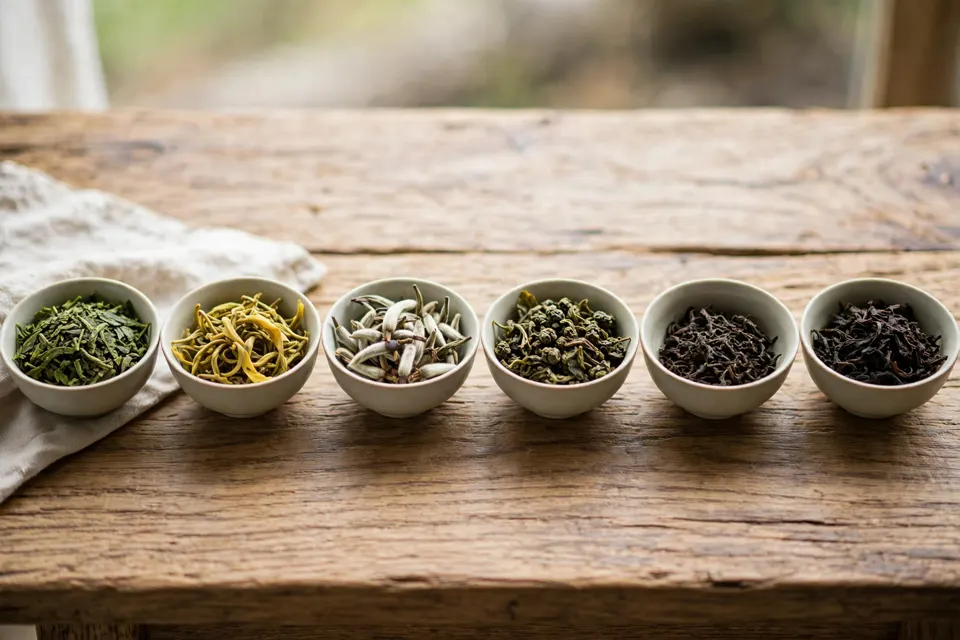
When people say Chinese tea, they usually mean tea made from one plant, Camellia sinensis, grouped into six kinds of Chinese tea by processing. Processing sounds technical, but in practice it comes down to a few choices: how much the leaves are allowed to change colour and flavour in air, how they are heated, rolled, dried, or pressed, and how long they are left to age. Learn those choices, and the six names stop feeling like a list to memorise.
Green tea
Green tea is heated soon after picking, which stops the leaves from changing much further. The result is usually fresh, grassy, or nutty, and light in the cup. It is the most common everyday tea in China, and also the most sensitive to water that is too hot, so let the kettle cool a little before brewing it.
Yellow tea
Yellow tea is rare outside China, and it sits close to green tea. After heating, the leaves are wrapped and left to warm gently, which softens the fresh edge and gives a smoother, slightly sweet cup. If you enjoy green tea but find it a little sharp, yellow tea is a gentle next step.
White tea
White tea is handled the least of all: the leaves are mainly withered and dried, with no rolling or heavy heating. The cup is usually light, soft, and subtly sweet, with a clean finish. Because so little is done to it, white tea shows the character of the leaf and the season very directly.
Oolong tea
Oolong covers the widest range of all six kinds, from light and floral to dark and roasted. The leaves are partly changed in air, then heated to stop the process at a chosen point. That is why two oolongs can taste almost like different teas: one maker may stop early for freshness, another later for roast and honey notes. Oolong is also the kind most often brewed gongfu style, in many short infusions.
Red tea, called black tea in English
In China this kind is called red tea, hong cha, after the colour of the liquor, while in English it is usually called black tea, after the colour of the dry leaf. The leaves are fully changed in air before drying, which gives a darker, maltier, and more robust cup. It is a forgiving tea to brew, and a good choice if you like a stronger, steadier flavour.
Dark tea, including pu-erh
Dark tea is pressed and left to change over time, sometimes for years. The best known example is pu-erh from Yunnan, which can be raw and lively when young, or smooth and earthy after aging or accelerated fermentation. Dark tea is the kind where storage matters most, and where a little patience is part of the flavour.
How to use this list
Do not try to learn all six kinds of Chinese tea at once. Pick one kind you already like, read its section again, and brew it a few times. Then pick the kind next to it on the list, and taste the two side by side. That contrast will teach you more than any chart, because you will feel, in your own cup, what processing actually does.