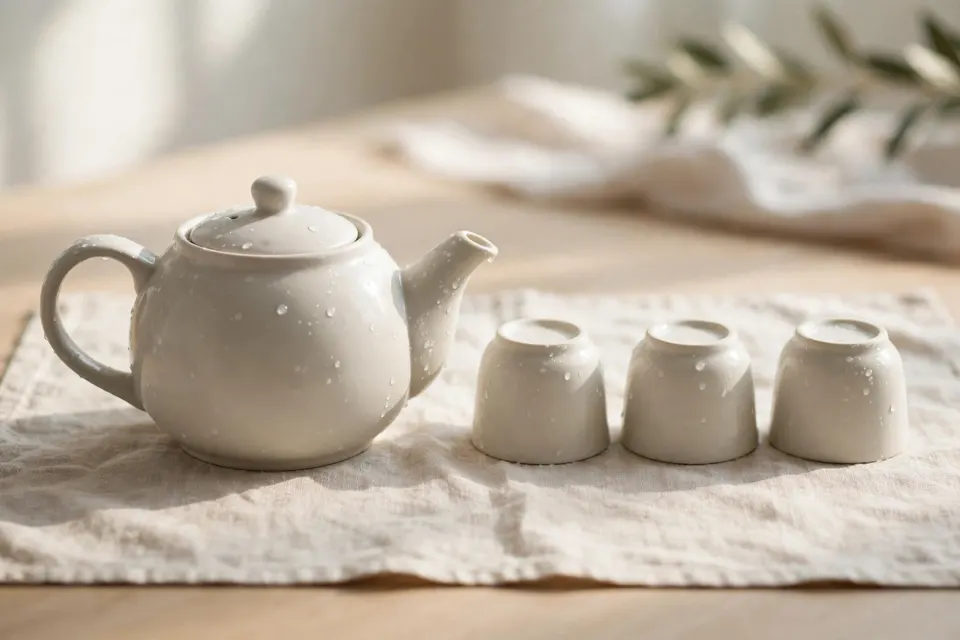
How to look after teaware starts here: good teaware does not need much looking after. It needs the right kind, and that depends on what it is made of. Porcelain, glass, and unglazed clay all behave differently, and most beginner damage comes from treating them all the same.
How to look after teaware starts with the simplest rule, which covers most pieces: rinse with hot water, and dry before you put anything away. Tea leaves left sitting in a pot will stain it and leave a stale smell behind. A quick rinse straight after drinking, while the pot is still warm, is easier than scrubbing a dried-on stain the next day.
Porcelain and glass are the forgiving ones
Porcelain and glass are the forgiving ones. Both are smooth and non-porous, so they do not hold on to flavour. Wash them with hot water, and if they need more, a little plain dish soap is fine — just rinse well, so no soap scent stays in the cup. Dry them fully before stacking, and do not stack a wet cup inside another one. Trapped water is what leaves marks and, over time, a musty smell.
Unglazed clay is different
Unglazed clay is different, and this is where beginners most often go wrong. Clay is porous by design: it absorbs a little of each tea it brews. That is part of its character, not a flaw. So do not wash a clay pot with soap, and do not put it in the dishwasher. Rinse it with hot water only, wipe it out, and let it air-dry with the lid off. If you use one clay pot, it is simplest to brew one kind of tea in it, so the flavours it picks up stay in the same family.
A few habits help every kind
A few habits help every kind of teaware last longer. Warm a cold pot with a little hot water before the first pour, rather than shocking it with boiling water straight from the kettle. Handle lids and spouts with dry hands, since most breakages happen when a wet lid slips. Store pieces where they will not knock against each other, and leave a little air around them rather than sealing them in a closed box while still damp.
If a stain has already set in
If a stain has already set in, do not reach for anything abrasive. Soak the piece in hot water for a while, then wipe it with a soft cloth. Most tea stains lift with patience rather than force, and a scratched glaze or a scuffed clay surface is harder to live with than a faint mark that fades over the next few brews.
You do not need special tools for any of this. A soft cloth, hot water, and a minute after each session will do. The point of caring for teaware is not to keep it perfect. It is to keep it pleasant to use: clean, dry, and free of yesterday's tea, so that tomorrow's tea tastes like itself.
That is the whole routine for how to look after teaware. Rinse, dry, and treat clay a little more gently than porcelain. Do that, and the small set you started with will still be the set you reach for a year from now.