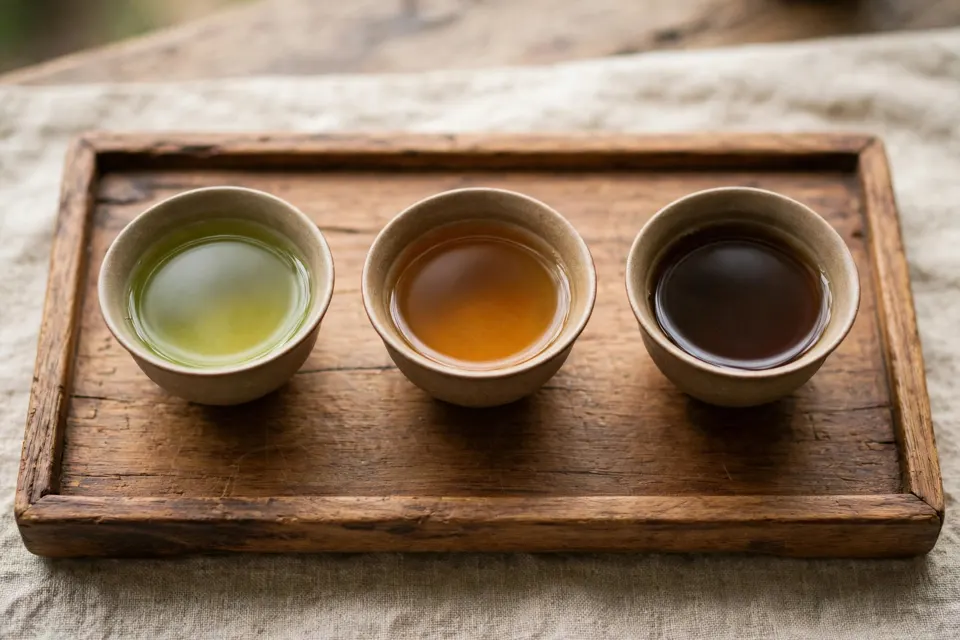
Walk into a tea shop and the names can feel like a test you did not study for. Longjing, Tieguanyin, Dianhong, Sheng Pu-erh. Here is the simpler map underneath all those names. The types of Chinese tea are usually grouped by how much the leaves are allowed to oxidise, and by how they are shaped and fired afterwards. That handling is what you taste.
Green tea: fresh and light
Green tea is heated soon after picking, which stops oxidation early. In the cup it usually tastes fresh, grassy, or lightly sweet, sometimes with a nutty or chestnut note. It is the most delicate of the families, and the easiest to ruin with water that is too hot. Use cooler water, steep briefly, and drink it soon after brewing. If you like light, clean flavours, start here.
Black tea: warm and round
In China, what English speakers call black tea is known as hong cha, or red tea, named for the colour of the liquor rather than the leaf. These leaves are fully oxidised, so the taste is warmer and rounder: malt, honey, dried fruit, sometimes a gentle cocoa note. It is forgiving to brew, takes boiling water well, and suits people who find green tea too light.
Oolong: the wide middle
Oolong sits between green and black tea, and it is the widest family of all. A lightly oxidised oolong can taste floral and almost like green tea. A heavily roasted oolong can taste toasted, nutty, and deep, almost like a different drink. If you only try one family to understand Chinese tea, try oolong, and try two very different ones: one light, one roasted. The contrast teaches more than any description.
Pu-erh: deep and earthy
Pu-erh comes from Yunnan and is pressed into cakes or bricks, then aged. Young raw pu-erh can taste bright and astringent. Aged pu-erh tastes deep, smooth, and earthy, sometimes like damp forest floor in the best sense. It is an acquired taste, and it is also the tea that rewards patience most: the same cake can change over years. Beginners do not need to start here, but it is worth knowing it exists.
White and yellow tea, briefly
White tea is minimally handled and tastes delicate, sweet, and soft — the quietest of the types of Chinese tea. Yellow tea is rare and gentle, somewhere near green tea but smoother. Both are lovely, and both are easy to overpay for as a beginner. Learn the four main families first; these will still be there later.
Which one should you try first?
If you like light flavours, start with a green tea such as Longjing. If you like warmth, start with a Dianhong black tea. If you are curious and want range, start with two oolongs, one light and one roasted. Buy small amounts, brew them the simple way, and notice what you reach for again. That second purchase is the real guide.