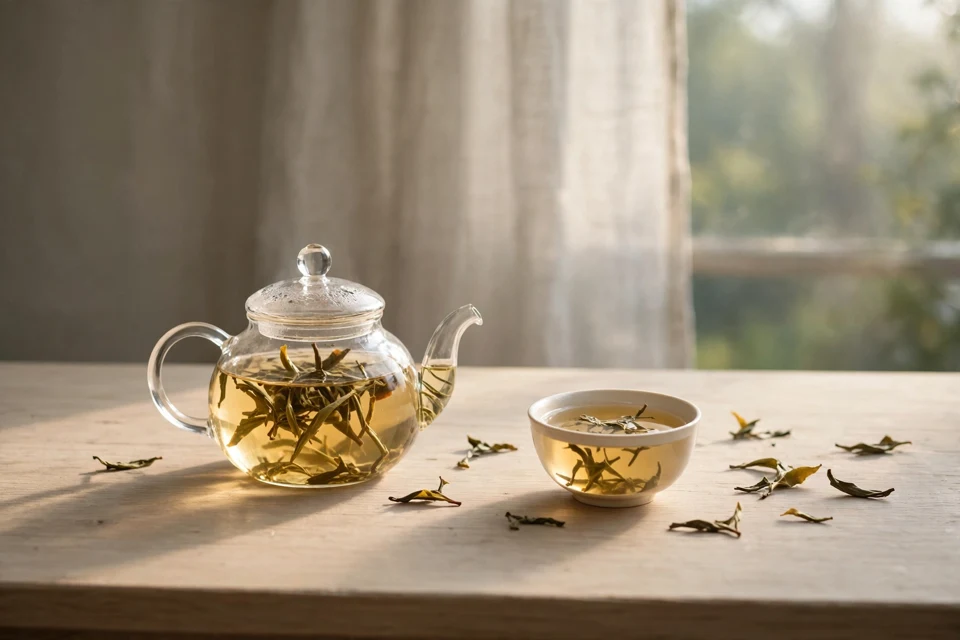
Most beginners do one thing wrong with loose-leaf tea: they brew it once and throw the leaves away. With a tea bag, that makes sense. With whole leaves, it does not. Good leaves are meant to be steeped several times, and the later cups are often the most interesting ones.
The idea behind how to re-steep tea leaves is simple. The first steep wakes the leaves up. The second and third steeps are where they fully open and show what they can do. By the fourth or fifth, the flavour softens and fades, and that is your sign to stop. Nothing about this needs special equipment — just the same leaves, the same pot, and fresh hot water.
How to do it
After you pour the first cup, leave the leaves in the pot. When you are ready for another cup, pour fresh hot water over them, at about the same temperature as before, and let them sit a little longer than the first time. A good rule of thumb: add roughly half a minute to each new steep. If the first cup took one minute, give the second a minute and a half, the third two minutes, and so on.
That extra time matters because the leaves have already given up their easiest flavours. A longer second steep pulls out the deeper, slower notes — which is exactly why the second cup often tastes rounder and less sharp than the first.
How many cups can you expect?
It depends on the tea, and on how much leaf you used. As a rough guide, delicate green teas usually give two or three good cups. Oolong and dark teas, whose leaves are rolled or pressed, often give four, five, or more, because they unfurl slowly and release flavour bit by bit. White teas sit somewhere in between. If a tea still tastes pleasant and clear, it has another cup in it. If it tastes thin, flat, or like warm water with a memory of tea, it is done — and that is fine. Not every tea has to go five rounds.
Why the taste changes
Expect the cups to differ, and enjoy that difference rather than fighting it. The first cup is usually the brightest and most fragrant. The second is often smoother and fuller, as the leaves open completely. Later cups get gentler and sweeter, sometimes with a completely different character — a tea that started grassy may finish soft and almost honey-like. Think of it less as one tea getting weaker and more as one tea telling its story in chapters.
This is also why small cups suit re-steeping so well. A small pot and small cups let you taste each chapter properly, instead of drinking one large mug and missing the changes.
Three mistakes to avoid
First, do not leave the leaves sitting in cold water between cups for hours. If you plan to come back later, drain the pot fully after each pour so the leaves are damp, not drowning. A drained pot can wait a few hours; a pot left full of cold water turns stale.
Second, do not re-steep yesterday's leaves. Once leaves have sat overnight, they are finished, however tempting it feels to save them. Start fresh the next day.
Third, do not expect every tea to reward re-steeping equally. Finely broken leaves and tea bags give most of their flavour at once, so a second cup will be faint. Whole, rolled, or pressed leaves are the ones that keep giving. If your second cup disappoints, it may be the leaf, not your technique.
That is really all there is to how to re-steep tea leaves: same leaves, fresh water, a little more time each round, and stop when the flavour stops pleasing you. It costs nothing, it wastes less, and it turns one cup into a slow little session. Once you have tasted a tea across three cups, a single cup will start to feel like stopping a song halfway through.